Can You Do This Yourself
Some opener trouble is a five-minute fix
If the door won't respond at all, check that the unit is plugged in and the breaker hasn't tripped - garage circuits share with other loads in a lot of these houses and trip more than people expect. If the safety sensors near the floor are out of alignment or have a cobweb across the lens, the opener will refuse to close and just blink at you; a clean lens and a nudge back into alignment solves that one.
What you shouldn't touch is the logic board, the motor gearing, or anything involving the high-voltage side of the unit
If the opener runs but the door doesn't move, or the gear is stripped and you hear the motor spin without pulling the chain or belt, that's a parts job, not a settings job. Same goes for openers that have started reversing mid-close on their own - that's often a failing circuit board, and swapping boards wrong on an older unit can brick it entirely.
One honest note: if your opener is original to a house built in the 1970s or 80s
Troubleshooting it yourself usually just burns time before you call anyway, because the part that's actually gone bad likely isn't stocked anywhere local and has to be sourced.
What Causes It Around Here
Housing in this service area runs from 1938 up through 2008, with the bulk of it dating to the 1960s and 70s across the 29 named communities we cover. A lot of those houses still have the opener that came with a remodel decades ago, or a replacement unit installed when the first one finally died - meaning you've got two generations of opener technology sitting in garages a few blocks apart, each failing in its own particular way.
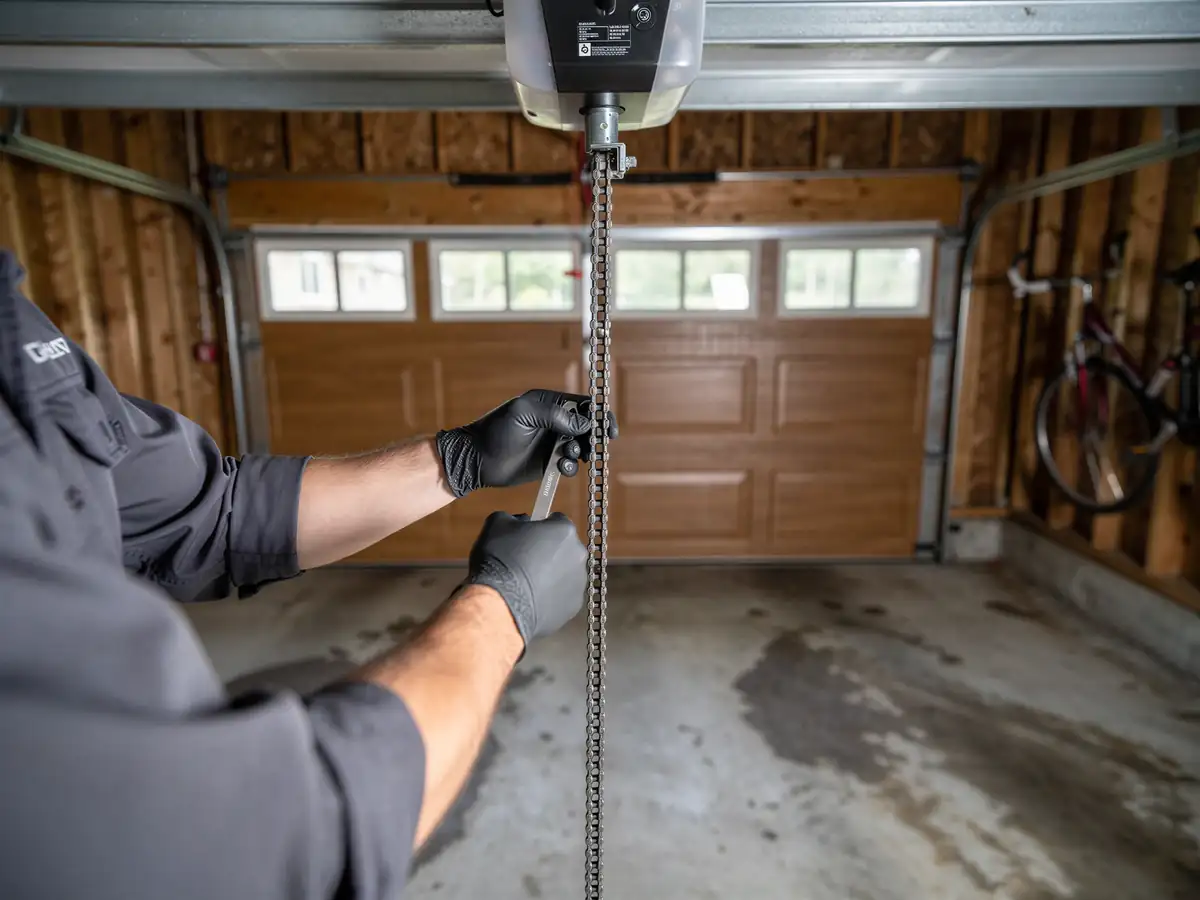
The older chain-drive units from that 1960s-70s wave tend to go out through gear wear: the plastic drive gear inside the housing strips teeth over years of use, and the door starts to lag or stall partway up. Newer belt and screw-drive units installed in houses from the later building boom fail differently - usually a logic board or a capacitor issue rather than a mechanical gear.
Climate plays a role too. This area sits in a mild band with occasional freeze risk, not the extreme heat or cold that cooks electronics fast, but the swing between a cold snap and a warm afternoon still puts stress on circuit boards and capacitors over the years, especially in detached garages that aren't insulated or heated. That slow thermal cycling is a quieter cause of board failure than people assume.
The Symptom
The most common call is an opener that runs - motor hums, light comes on - but the door doesn't move or only moves a few inches before stopping. That's almost always a stripped gear on an older chain-drive unit, or a drive belt that's slipped its track on a newer one.
A close second is a door that reverses right before it touches the floor, every time, like it's hitting something invisible. That's the safety sensor circuit, or on older units, a failing logic board that misreads the close signal. Flickering opener lights paired with the remote working intermittently usually points to a failing capacitor rather than the remote itself - people replace batteries for months before finding that out.
Then there's the opener that's simply gone silent: no light, no hum, nothing. Check the outlet and breaker first. If power is confirmed and it's still dead, the board has likely failed outright, and on an opener from the older end of this area's housing stock, a full unit swap is usually more practical than sourcing a board for a model that's been out of production for years.
The Cost of This Job
We don't have a flat number to post here, and honestly, anyone who quotes one over the phone without seeing the unit is guessing
Opener repair cost depends on whether it's a sensor alignment, a capacitor, a logic board, or a full gear kit - and on chain-drive units from the older end of the local housing stock, parts availability matters as much as labor.
What we can tell you
If your opener is original equipment from a decades-old installation and the board has failed, replacement is often the more sensible call than chasing down a discontinued part. If it's a newer belt-drive unit with a bad capacitor or slipped belt, repair is usually the quicker and cheaper path.
We serve the wider area out from San Ramon
Including nearby communities like Blackhawk, Norris Canyon, and Camino Tassajara, each a few miles out, and pricing doesn't change by town - it changes by what's actually broken.